Designing an indoor playground that drives repeat visits and sustained revenue is a discipline that blends child development, safety engineering, commercial planning and operations design. Too many projects focus on “looking nice” and miss the structural, behavioural and operational choices that produce long-term value. Below is a working framework — detailed, tested and actionable — that you can apply to any scale of project.
Before design sketches, document a one-page brief that answers:
Primary objective: traffic driver for mall / standalone FEC / ancillary attraction for restaurant / educational playspace.
Target audience: age bands (0–3, 3–6, 6–12), household income, family vs. school groups.
Operating model: free play + paid add-ons; ticketed timed sessions; membership; party & events; school bookings.
Weekly operating hours & peak times.
Target KPIs (first 12 months): avg daily footfall, conversion rate, avg ticket price, membership penetration, target party bookings per week.
Why: design decisions (material spec, staffing, sightlines, capacity) must be driven by what the business intends to achieve. A playground designed for high-volume transient mall traffic is fundamentally different from a premium membership FEC.
Children’s play needs and parental expectations differ meaningfully by age. Effective zoning increases throughput, reduces incidents, and raises per-visit spend.
Recommended allocation by commercial objective (adjust by brief):
Toddler zone (0–3): 15–25% of net play area — soft, low elements, sensory walls, enclosed for safety.
Preschool / Early Learning (3–6): 30–40% — low climbing, role-play, interactive panels.
Active / Adventure (6–12): 25–40% — higher structures, nets, slides, obstacle course.
Family / Social & F&B / Party Rooms: 15–25% (separate rooms for parties).
Circulation & Buffer / Maintenance: 5–10% (clear emergency egress and service access).
Design objective: each zone maximizes dwell time and allows tiered pricing (toddlers free/low, adventure higher, parties premium).
Parents are the purchasers and the stayers. Design to maximize parental comfort and perceived safety:
Single-view seating: Main seating should have line-of-sight to at least 70–80% of play areas.
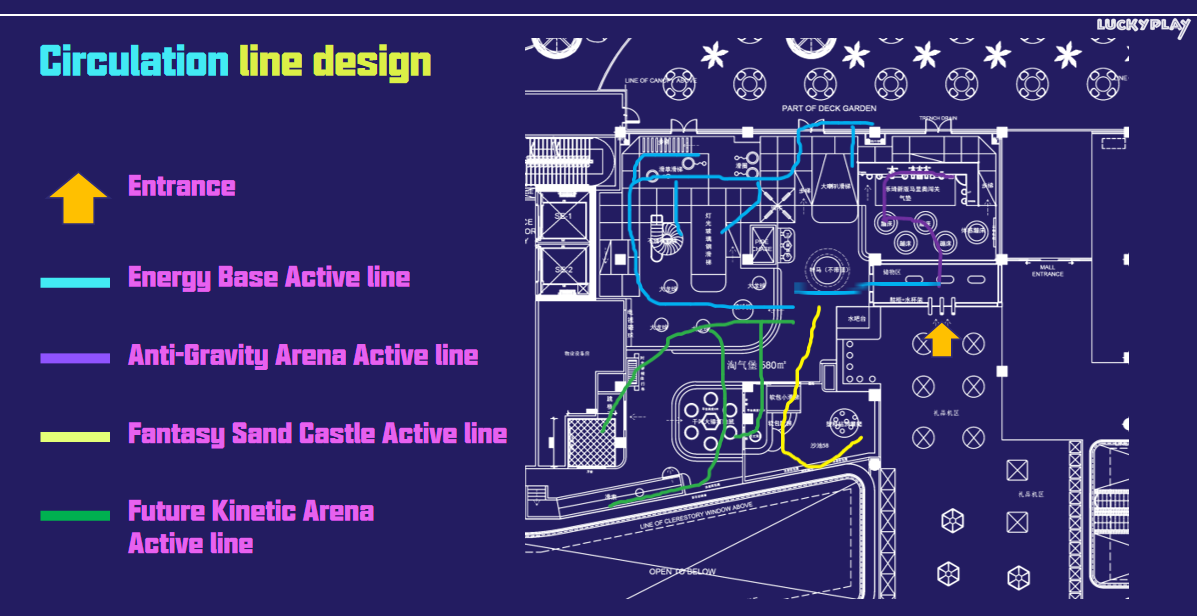
Logical circulation: Entrance → ticket & retail → restroom/locker → play core → café → exit. Avoid dead ends.
Staggered activity placement: active zones near supervised café; toddler zone adjacent to family seating.
Acoustic planning: soft finishes, baffles and sound zoning — loud active zones separated from family rest zones.
Outcome: better parental comfort = longer dwell time = higher F&B & secondary spend.
Differentiate structure safety from materials testing — both are necessary.
Structural safety (design standards):
EN1176 (Europe) and ASTM F1487 (North America) are the principal standards for playground structure and dimensional safety (clearances, fall zones, entrapment, guardrails, load calculations). Designs must be reviewed against these standards and local regulations.
Materials & performance testing:
SGS / TUV / Intertek reports validate materials (PVC, foam, plastics) for toxicity, flame retardancy and aging.
ISO9001 demonstrates process control at manufacturer level.
Practical build specs (industry-level guidance, adapt to project):
Structural steel: commercial projects typically use steel tubing ≥ 2.0 mm wall thickness with hot-dip galvanizing + powder coat for corrosion resistance.
Foam padding: use commercial grade CMHR or high-density EPE/EVA; select density and ILD rating to meet impact attenuation targets and durability.
Upholstery: phthalate-free, flame-retardant PVC/PU with abrasion rating (Martindale) suitable for heavy use.
Plastics: HDPE/ABS with UV stabilizers for exposed pieces.
Always require suppliers to provide dated test reports and traceability: design report (EN/ASTM compliance), material test (SGS TDS), and manufacturer quality system proof.
Design a balanced equipment mix that supports both excitement and repeatability:
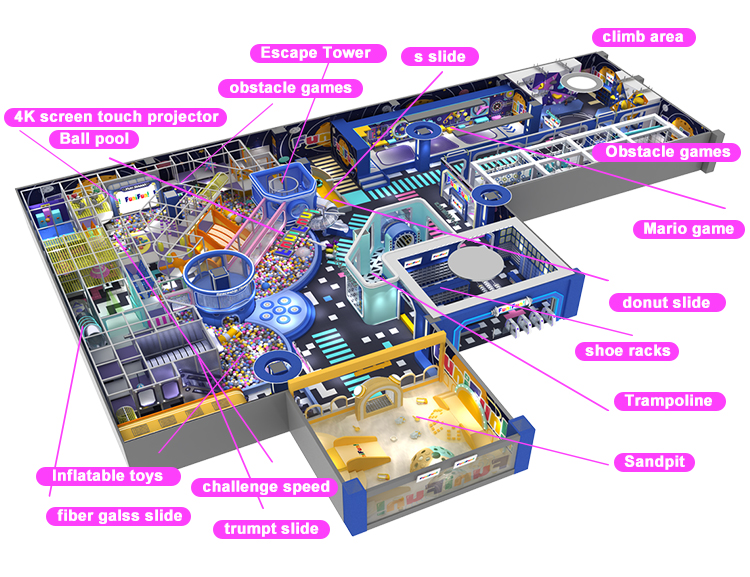
High throughput core module (central multi-level play structure): encourages continuous circulation.
High margin/low footprint offerings: party rooms, hostable experiences, add-on workshops, retail kiosks.
Repeatability engines: rotating interactive modules (monthly/quarterly changeouts), seasonal overlays, projection/AR zones.
Quiet anchors: reading / maker / craft corners that increase stay time and attract caregivers.
Rule of thumb: avoid >60% of floor area in single-use items; modular systems that can be reconfigured keep the concept fresh.
Design must anticipate operations: throughput modelling, staff sightlines, cleaning access.
Staffing model (example):
Small (100–200 m²): 2–4 staff (reception, safety monitor, café/cleaning rotational).
Medium (300–700 m²): 4–10 staff (multiple monitors, party host(s), café supervisor).
Large (800–2000 m²+): dedicated operations manager, multiple shift teams, maintenance tech.
Maintenance & spare parts:
Design for replaceable wear components (zip covers, foam inserts, bolt guards). Maintain a 6–12 month spare parts kit on opening. Budget annual maintenance at 2–5% of CAPEX depending on usage intensity.
Cleaning & hygiene: embedding anti-microbial finishes, specifying easy-wipe surfaces and designing wash points minimize downtime.
Design should enable multiple revenue streams:
Timed ticketing / session slots: increases capacity management and perceived value.
Memberships & season passes: design exclusive members areas or early access offerings.
Birthday & private events: design modular rooms with AV and catering access; these can be 3–6× per sqm revenue vs open play.
F&B & retail adjacency: sightline to café and impulse retail increases per-visit spend.
Workshops & classes: plug spaces for weekday income.
Target goal: convert 10–20% of walk-ins into paying members within first 12 months in an optimized model.
Modern discovery is visual. Include “photo moments” that are:
Highly shareable (scale, color contrast, lighting).
Branded subtly with logo/hashtag placements.
Safe and easily staged for group photos (platforms, frames, lighted signage).
A single viral photo area can reduce initial customer acquisition costs significantly.
Plan for technical needs from the start:
Electric & AV capacity for interactive modules and projection.
HVAC sizing for high occupancy; airflow must be designed to avoid stagnation and overheating.
Wiring & maintenance access for sensors and sound.
Fire & egress: integrate sprinkler systems and route clearances (consult local code early).
Plan upgrades in the specification: conduits and reserved zones for future interactive tech without full rebuild.
Design with metrics in mind and measure continuously:
Footfall / conversion / average dwell time (targets vary by model: mall mid-range: 80–200 visits/day; benchmark locally).
Avg Revenue per Visit (ARPV): tickets + F&B + retail + parties. Aim to increase ARPV by 15–30% through upsell mechanisms.
Membership penetration: % of regular visitors on pass. Target 10–25% depending on market.
Repeat rate (30/60/90 days): track returning visitors; adjust programming.
Use these metrics to drive small design tweaks (reallocation of space, new modules, operational hours).
Site & space
Ceiling clearance ≥ 3.5 m (soft play); ≥ 5 m for taller slides / nets.
Column spacing and floor load capacity verified.
Accessible restrooms and family facilities within ≤ 30 m.
Safety & compliance
EN1176/ASTM F1487 design review & report.
SGS/TUV material reports for foam, PVC, plastics.
Fire compliance & emergency egress signed off.
User experience
Clear age zoning & signage.
Parent sightlines from ≥ 70% of seating.
Comfortable seating, USB power, Wi-Fi.
Operations
Dedicated maintenance access & spare parts kit.
Daily inspection checklist, staff training plan.
Ticketing and CRM system integrated.
Commercial
Party rooms with catering access & AV.
F&B layout with visibility and service flow.
Retail space for merchandise.
Over-theming at the cost of functionality: theme should enhance play, not obstruct flow.
Insufficient sightlines: leads to higher staffing and lower parental trust.
Single revenue dependence: don’t rely solely on walk-in tickets.
Under-spec’d materials: choose higher initial buy-in for lower lifetime cost.
Ignoring noise and ventilation engineering: impacts dwell time and repeat visits.
Week 0–2: Business brief, target KPIs, site survey, CAD.
Week 3–4: Concept 2D & 3D schematic; zoning approval.
Week 5–8: Technical design, materials spec, safety checks (EN/ASTM mapping).
Week 9–12: Manufacturing & pre-assembly testing (dry run).
Week 13–14: Shipping & logistics.
Week 15–16: On-site installation, commissioning, staff training.
Week 17: Soft opening, KPI baseline measurement.
Design is the mechanism by which a playground turns space into revenue. The best designs are built from a commercial brief, validated by safety standards and proven by operational metrics. A robust design does three things simultaneously:
Maximises safe usable play value per square metre
Minimises operational friction and maintenance
Creates repeated, varied reasons for families to return


